
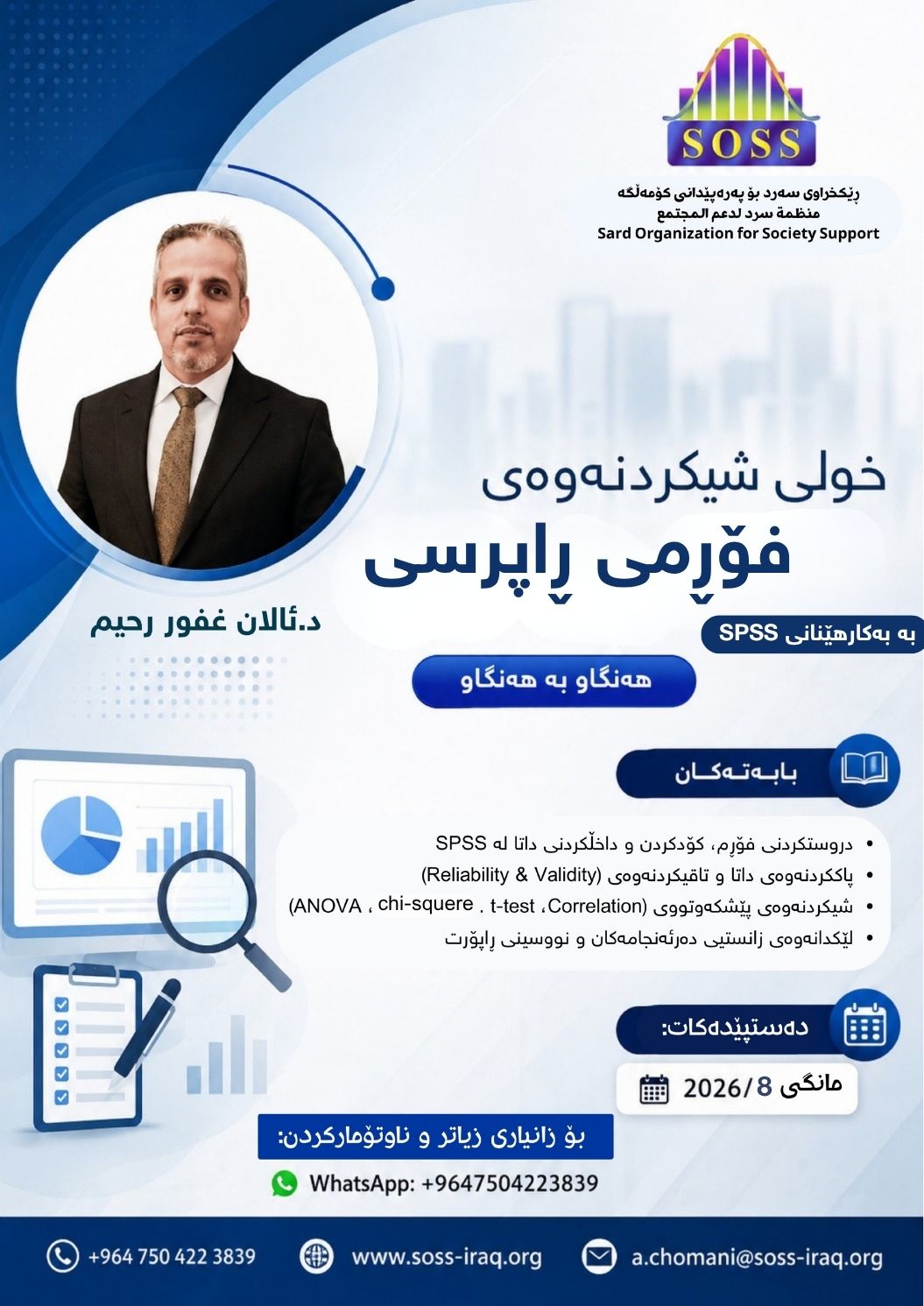
Survey Form Data Analysis Course using SPSS – Step-by-Step
Course Overview
Survey design, data collection, and statistical data analysis are fundamental components of scientific research, academic studies, organizational reports, and monitoring and evaluation projects. Developing the ability to analyze survey data accurately is essential for producing reliable evidence and making informed decisions.
This practical, step-by-step training course is designed to guide participants through the complete workflow of survey data analysis using IBM SPSS Statistics. Beginning with data preparation and management, the course progressively introduces descriptive and inferential statistical techniques, enabling participants to confidently analyze survey data and interpret statistical outputs for research and professional reporting.
Throughout the training, participants will work with real survey datasets and practical examples, ensuring that every statistical procedure is demonstrated through hands-on applications relevant to theses, dissertations, research projects, institutional assessments, and organizational reports.
Course Content
The course provides comprehensive practical training in survey data analysis, including:
- Survey data preparation, coding, and cleaning
- Descriptive statistics and data visualization
- Reliability analysis (Cronbach’s Alpha)
- Independent and Paired Samples t-tests
- Non-parametric alternatives (Mann–Whitney U and Wilcoxon Signed-Rank tests)
- One-Way ANOVA
- Chi-Square Test
- Correlation analysis (Pearson and Spearman)
- Selecting the appropriate statistical test
- Interpreting SPSS output and reporting statistical results
Training Skills Acquired
Upon successful completion of the course, participants will be able to:
- Prepare and organize survey datasets professionally.
- Select the most appropriate statistical test for different research questions.
- Perform descriptive and inferential statistical analyses using SPSS.
- Conduct and interpret Independent and Paired Samples t-tests.
- Apply non-parametric statistical methods when parametric assumptions are not met.
- Compare multiple groups using ANOVA.
- Analyze relationships between categorical variables using Chi-Square tests.
- Measure associations between variables through correlation analysis.
- Interpret SPSS outputs accurately and report findings confidently in research papers, theses, and professional reports.
Course Duration
7 Days
Delivery Modes
The course is offered in two flexible formats:
Offline (Face-to-Face)
Participants attend practical classroom sessions with direct instructor guidance, discussions, and hands-on statistical exercises.
Online
Participants can join remotely through an online learning platform, allowing full participation in lectures, practical demonstrations, discussions, and course activities from any location.
How to Register
Click this to fill out the entry form
Course Instructor
Asst. Prof. Dr. Alan Ghafour Rahim
Department of Statistics and Informatics
Salahaddin University – Erbil
Start Date
Early August 2026
Target Audience
This course is suitable for:
- Undergraduate and postgraduate students
- Master’s and PhD researchers
- University lecturers and academic staff
- Researchers and research assistants
- NGO, INGO, governmental, and private sector professionals
- Monitoring and Evaluation (M&E) officers
- Data analysts
- Anyone interested in developing practical survey data analysis skills using SPSS
Prerequisites
Participants are encouraged to bring a laptop with IBM SPSS Statistics installed. Prior knowledge of research methods is helpful but not required, as the course follows a structured, step-by-step approach suitable for beginners as well as those wishing to strengthen their statistical analysis skills.
Training Approach
The course emphasizes practical learning through real survey datasets, guided exercises, and interactive discussions. Participants will gain hands-on experience with statistical analyses commonly used in academic research and organizational studies, enabling them to confidently move from raw survey responses to meaningful statistical conclusions and professionally presented reports.